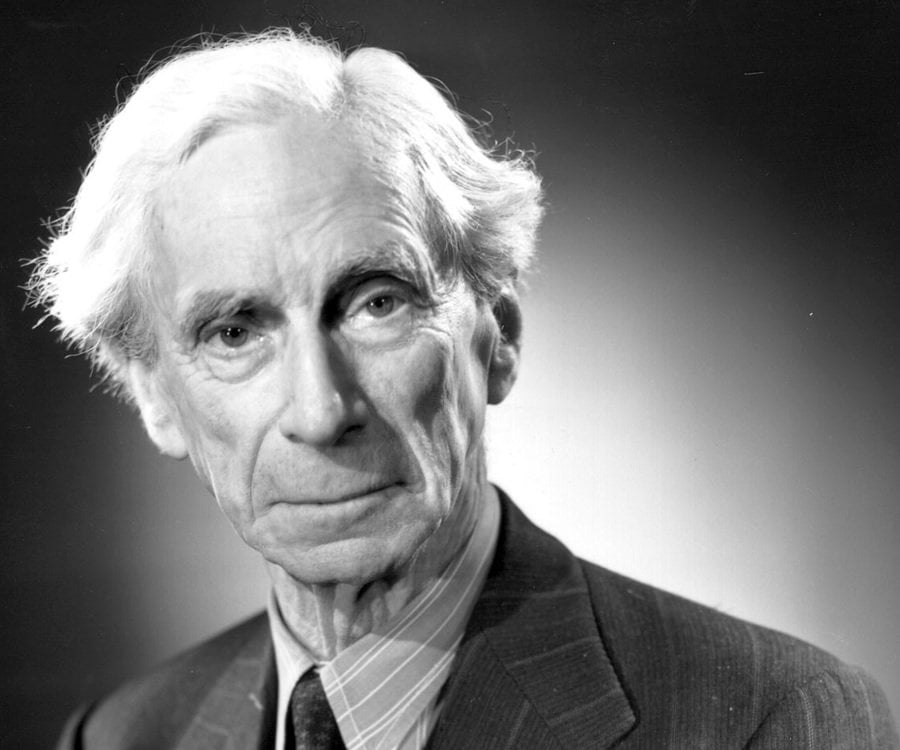
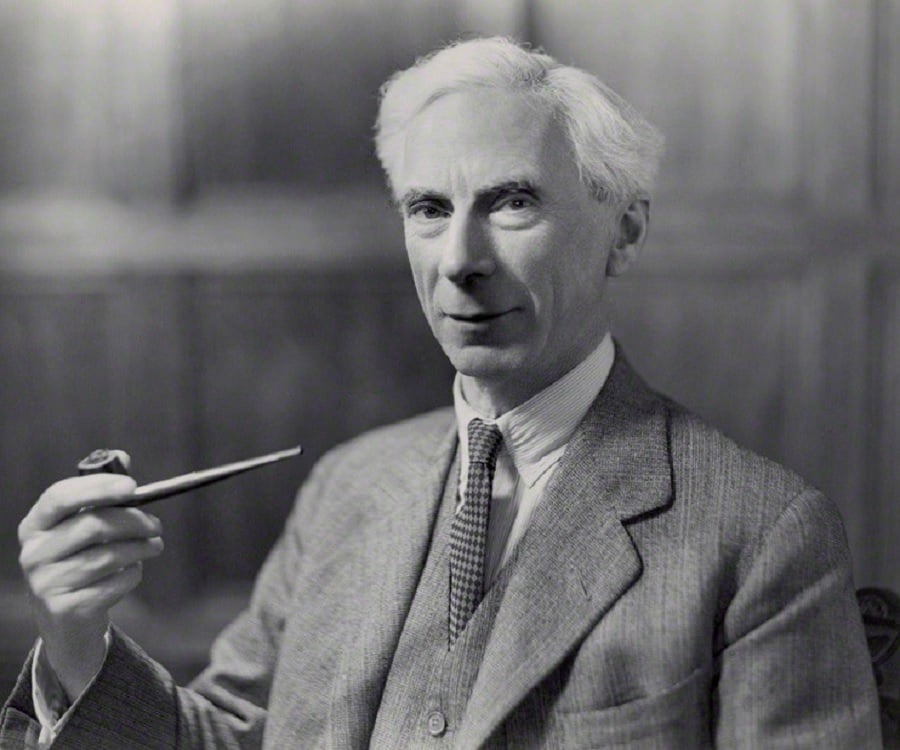
Bertrand Russell was one of the most prominent philosophers and mathematicians in history. To know more about his life, read on his brief biography.

Bertrand Russell

PrintRecommend This Site
Famous as Philosopher
Born on 18 May 1872
Born in Ravenscroft, Trellech, Monmouthshire, Wales
Died on 02 February 1970
Nationality United Kingdom
Works & Achievements An Essay on the Foundations of Geometry, the Principles of Mathematics, On Denoting, the Problems of Philosophy, the Analysis of Mind, Political Ideals, Marriage and Morals and In Praise of Idleness

Bertrand Arthur William Russell, 3rd Earl Russell, OM, FRS, is one of the finest names in the list of great philosopher, logician, mathematician, historian, and social critic from Great Britain. He is also a proud receiver of the Nobel Prize in literature in 1950. Throughout his life, Russell shuffled himself as a liberal, a socialite and a pacifist but never agreed to adapt any of these intellectually. In 1900s, Russell escorted the British "revolt against idealism". Russell is also believed to be the founder of the analytic philosophy, accompanied by his ancestor Gottlob Frege and apprentice Ludwig Wittgenstein. Russell's famous philosophical essay "On Denoting" has been acknowledged as a "paradigm of philosophy". Russell was also a remarkable anti-war activist and also imprisoned for carrying a pacifist activism during World War I. Eventually, he also raised voice against Adolf Hitler and criticized Stalinist totalitarianism. He even campaigned against the involvement of United States in the Vietnam War. Russell also acted as a blunt supporter of nuclear disarmament. The works of Bertrand Russell had a noticeable impact on logic, mathematics, set theory, linguistics and specifically on philosophy of language, epistemology, and metaphysics.

Bertrand Russell Childhood & Early Life
Bertrand Russell was born on May 18, 1872 at Ravenscroft, Trellech, Monmouth shire, Wales to Viscount Amberley and Katharine Louisa. He belonged to a liberal British aristocracy family. His family took part in each of the great political events, right from the Dissolution of the Monasteries in 1536-40 to the Glorious Revolution in 1688–89 to the Great Reform Act in 1832. He also had two older siblings; Frank and Rachel. In June 1874, Russell’s mother passed away suffering from diphtheria which was soon followed by the death of his sibling, Rachel. Two years later in 1876, his father died of bronchitis. After early death of their parents, Frank and Bertrand grew up under the vigilance of Victorian grandparents, who resided at Pembroke Lodge in Richmond Park. After the death of his grandfather, his grandmother became a dominating figure in his life. Therefore, she successfully petitioned a British court to keep aside Amberley will’s provision of raising children as agnostics. Russell’s views on social justice and principles were highly influenced by her grandmother. 
 
Russell was often struck with pangs of loneliness and seclusion as a teenager, due to which, he often planned to commit suicide. He received no formal education at school and studied at home only, by different tutors. Later, Frank acquainted him with the work of Euclid, which actually brought a great turn in the life of Russell. During the developing and innovative days of his life, he also discovered Percy Bysshe Shelley’s work. Russell also spent his teenage in denoting a deeper view on Christianity. Later, he got scholarship to read for the Mathematical Tripos at Trinity College, Cambridge. Russell started studying in the same in the year 1890. He became friends with G.E. Moore and got influenced by Alfred North Whitehead, who introduced him to the Cambridge Apostles. In short period of time, Russell became a pro at mathematics and philosophy. He graduated as a high Wrangler in 1893. In 1895, he became a fellow in philosophy.
 
Early Career
In 1896, Russell commenced publishing his work with German Social Democracy, a political study that was the initial indication of a lifelong interest in political and social theory. The same year only, he started teaching German social democracy at the London School of Economics. Russell was a member of the “Coefficients Dining Club” of social reformers which was established by the Fabian campaigners, Sidney and Beatrice Webb in 1902. He denoted himself immensely into the study of the foundations of mathematics at Trinity. During the same time, he originated “Russell's paradox”, challenging the bases of the set theory. His first foremost book on mathematical logic got published in 1903 named “The Principles of Mathematics”. The book revealed that mathematics could be understood from a very small number of principles and contributed considerably to logicism cause.
 
In 1905, he completed his essay “On Denoting”, which was later published in the philosophical journal, Mind. In 1908, he became associated with the Royal Society. Also, Russell and Whitehead together wrote the book “Principia Mathematica”, whose first three volumes got published in 1910. Both the books published, gave Russell so much popularity that he became world famous in this stream. In the same year, he became the lecturer in the University of Cambridge. Soon after, he got an approach from Ludwig Wittgenstein, a student of the Austrian engineering. This student became a Ph. D student under Russell and he seen him as a genius and a successor of all his works on logic. Russell used to spend a considerable time in dealing with various phobias of Wittgenstein. In 1918, he lectured on “Logical Atomism”, his own version on these ideas.  
 
First World War
During this war period, Russell became one of the very few intellectuals who were involved in pacifist activities. In 1916, he was thrown from Trinity College because of his opinion under the ‘Defence of the Realm Act’. He was also fined of 100 pounds, but he denied payment of the same in the hope that he would be imprisoned. They did not send him in prison, rather sold his books in auction to raise money. Russell was given back his responsibilities in 1919, but resigned a year later. In 1926, he became a Tarner Lecturer and later, from 1944-49, became a fellow again. Later, Russell was charged of the lecturing in the public against welcoming the US to enter the war on Britain's side. As a result, he was imprisoned for six months in Brixton prison. Russell was released in September 1918.
 
In the August of 1920, Russell went to Russia as a part of an official delegation directed by the British government to investigate the Russian Revolution effects. His experiences destroyed his prior temporary support for the revolution. He also wrote a book on his Russia trip’s experiences titled “The Practice and Theory of Bolshevism”. Russell started lecturing in Beijing on philosophy, which lasted only a year. During his days in China, he became quite sick with pneumonia.  As a result, wrong report of his death got published in the Japanese press, but later his second wife, Dora cleared the misconception. Russell came back to England on August 26, 1921. It was during this time that he came out with some very famous books on matters of physics, ethics and education to the common man. In 1927, Russell established the experimental Beacon Hill School, but left it in 1932. In 1931, following Frank’s death, Russell became the 3rd Earl Russell.
 
Second World War
Russell stood against therearmament of Nazi Germany but remolded his views in 1940, agreeing that a World War is of ultra-importance than defeating Adolf Hitler. The same year itself, he secured the job of a professor at the City College of New York, but after a voice raised by public; the appointment was abolished by a court. In 1943, he acquired an attitude towards large-scale warfare, “Relative Political Pacifism”. Thereafter, he became a part of the Barnes Foundation and lectured on the history of philosophy. These lectures proved to be of great importance in setting the base of “A History of Western Philosophy”. He returned back to Britain in 1944 and was again appointed as a lecturer of Trinity College.   
 
Later Life
Russell took part in many broadcasts on BBC. He gained a lot of popularity, also apart from his academic circle, as an author of magazine or newspaper articles. His book A History of Western Philosophy (1945) became one of the best sellers.
Russell was also one of the 24 survivors of the airplane crash in 1948. On 9 June 1949, in the King’s Birthday Honours, Russell was awarded with the Order of Merit and the following year with the Nobel Prize in Literature. In 1962, he also played a public role in the Cuban Missile Crisis. Most of the years in 1950s and 1960s, Russell was engaged in a number of political causes. Also, in 1955, a document, “Russell–Einstein Manifesto” was signed by 11 most eminent nuclear physicists and intellectuals of that period. In 1963, he received Jerusalem Prize. He published his autobiography consisting of three volumes in 1967, 1968, and 1969. In 1969, he raised voice against some crimes. His last political statement came out on 31 January, 1970 which blamed Israeli aggression in the Middle East and asked for Israeli to withdraw from the territory occupied in 1967.  
 
Personal Life
Russell married to the AmericanQuaker Alys Pearsall Smith on 13th December, 1894 but the couple parted ways in 1921. During the same period, Russell had passionate affairs with numerous women including actress Lady Constance Malleson. On September 27, 1921, Russell tied the nuptial knot again, this time to his loverDora Black. She was six months pregnant at the time of wedding. They had three children John Conrad Russell, 4th Earl Russell, born on November 16, 1921, Katharine Jane Russell born on December 29, 1923 and Harriet Ruth, born on July 8, 1930. It is believed that he also had an affair with Vivienne Haigh-Wood, first wife of T. S. Eliot during this time. Dora and Russell got separated in 1932 as a result of the Dora’s extramarital affair. Later, Russell married Patricia (“Peter”) Spence on January 18, 1936. They had a son Conrad Sebastian Robert Russell, 5th Earl Russell. In 1952, Spence and Russell got divorced. Russell married again with Edith Finch on December 15, 1952.
 
Death
Russell died on February 2, 1970 due to influenza at his home in Penrhyndeudraeth, Merionethshire, Wales. Bertrand Russell was cremated on 5th February, 1970 in Colwyn Bay. According to the will of Russell, no religious ceremony took place on his cremation; his ashes were later spread over the Welsh mountains.

Bertrand Russell
Bertrand Russell

Bertrand Russell Timeline:
1872: Russell was born on May 18.
1890: Entered Trinity College, Cambridge.
1893: Awarded first-class B.A. in Mathematics.
1894: Completed the Moral Sciences Tripos (Part II).
1894: Got married to Alys Pearsall Smith.
1895: Became a Fellow at University of Cambridge
1896: Appointed as a lecturer at the London School of Economics.
1899: Appointed as a lecturer at Trinity College, Cambridge.
1902: Discovered Russell's paradox.
1903: Published his first important book on mathematical logic, “The Principles of Mathematics”
1905: Completed his essay “On Denoting”.
1908: Elected Fellow of the Royal Society.
1910: Became a lecturer at University of Cambridge
1916: Fined 100 pounds and dismissed from Trinity College as a result of anti-war protests.
1918: Imprisoned for six months.
1921: Divorced from Alys and married Dora Black.
1927: Opened experimental school with Dora.
1931: Became the 3rd Earl Russell, upon the death of his brother.
1932: Divorced from Dora.
1936: Married Patricia (Peter) Helen Spence.
1940: Appointed at City College New York
1943: Became a part of Barnes Foundation.
1949: Awarded the Order of Merit.
1950: Awarded Nobel Prize for Literature.
1952: Divorced from Spence and married to Edith Finch.
1955: Released Russell-Einstein Manifesto.
1963: Established the Bertrand Russell Peace Foundation.
1970: Died on February 2. 

PrintRecommend This Site