Birthday: May 5, 1818 (Taurus)
Born In: Trier, Germany
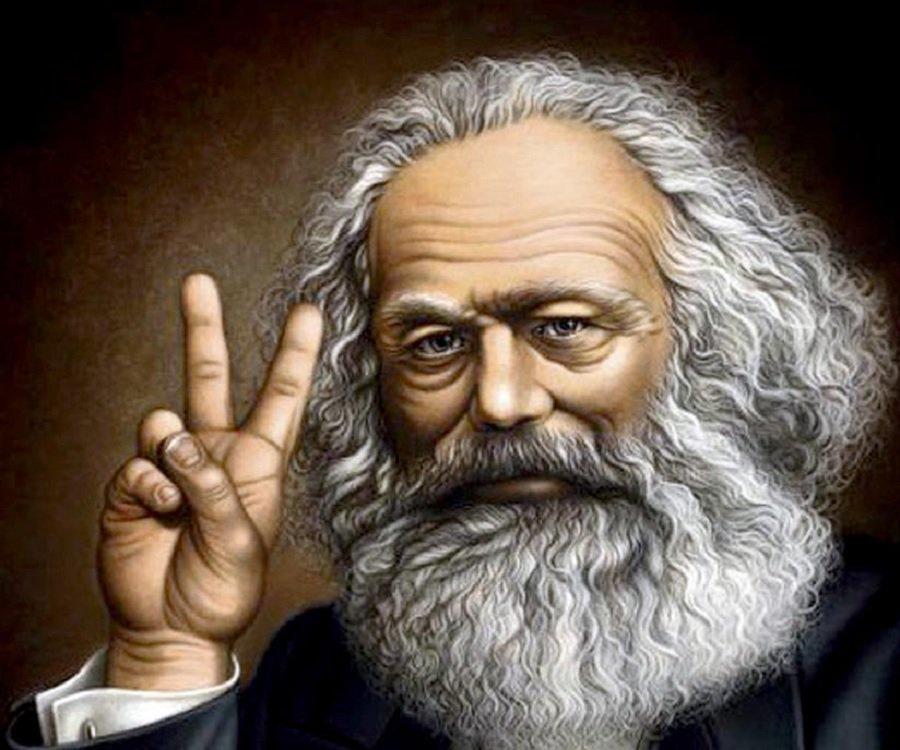
Karl Marx was a 19th-century philosopher, political economist, and revolutionary, who gave socialism a scientific foundation. Marx was devoted to the study of philosophy and history from a young age and was about to become an assistant professor in philosophy before his life took a different direction and he became a revolutionary. From a very young age, he started participating in a number of political activities and addressed a wide variety of social concerns. He is known for, among other things, his analysis of history and his arguments for a logical understanding of socioeconomic amendment through radical action. While Marx was a relatively undistinguished figure in his lifetime, his philosophies, which later came to be known as ‘Marxism’, began to wield a major impact on workers’ movements shortly after his death. The revolution that he instigated reached its apex when the Marxist Bolsheviks emerged victorious during the Russian October Revolution and soon different theoretical variants of communism began branching out from ‘Marxism’ such as Stalinism, Trotskyism, and Leninism. Some of his most famous works like ‘The Communist Manifesto’ and ‘Das Kapital’ had great influence on political leaders like Vladimir Lenin, Mao Zedong, and Leon Trotsky.
Recommended For You
German Celebrities Born In May
Also Known As: Karl Heinrich Marx
Died At Age: 64
Spouse/Ex-: Jenny von Westphalen
father: Herschel Marx
mother: Henriette Marx
siblings: Caroline Marx, Eduard Marx, Emilie Conradi, Henriette Marx, Hermann Marx, Louise Juta, Mauritz David Marx, Sophia Marx
children: Edgar (1847–1855), Henry Edward Guy, Jenny Caroline (m. Longuet; 1844–83), Jenny Laura (m. Lafargue; 1845–1911)
Born Country: Germany
Quotes By Karl Marx Economists
place of death: London, England
Ancestry: Dutch German
Diseases & Disabilities: Pleurisy
Cause of Death: Bronchitis
Founder/Co-Founder: Modern sociology
education: Humboldt University Of Berlin, University Of Bonn, University Of Jena
Recommended For You
Karl Marx was born in Trier, in the Kingdom of Prussia of the Lower Rhine into an Ashkenazi Jewish family. Karl’s father, Herschel Marx, was a lawyer and his mother, Henrietta Pressburg, was a semi-literate Dutch Jew. He was the third of nine children born to his parents and was baptized in the Lutheran Church.
He was privately educated until 1830 before being enrolled at the University of Bonn, where he pursued literature and philosophy. He joined the Poets’ Club, a radical group, and the ‘Trier Tavern Club Drinking Society’, and later served as the club’s president.
His academic performance at the University began to deteriorate, following which, he was shifted to the more disciplinal, University of Berlin, by his father. He soon became more focused and pursued law, and at the same time became interested in the works of the prominent philosopher, G.W.F Hegel. He also joined a local guild that advocated ‘Hegelianism’.
After the sudden death of his father, the income of his family plummeted and to support his family, he began writing. He wrote a number of fiction and non-fiction works but gave up writing after discovering his love for art history, philosophy, and languages. He completed his dissertation titled ‘The Difference Between the Democritean and Epicurean Philosophy of Nature’ in 1841.
He moved to Cologne in 1842 and became a journalist for the radical newspaper, ‘Rheinische Zeitung’, earning a moderate income to support his family. Through this newspaper, he began expressing his views on social issues and economics and published an article strongly criticizing the Russian monarchy. Subsequently, Tsar Nicholas I requested the Prussian government to ban the Rheinische Zeitung, and as a result, the newspaper was shut down in 1843.
Marx moved to Paris in October 1843 and became the co-editor of the new radical newspaper, the ‘Deutsch-Französische Jahrbücher’, which worked towards offering a common platform to both the German and French radicals. He contributed two articles to the newspaper titled, ‘On the Jewish Question’ and ‘Introduction to a Contribution to the Critique of Hegel’s Philosophy of Right’. However, only one of them was published in 1844 and it was well-received by readers and critics.
Owing to satirical odes on King Ludwig of Bavaria, German states banned the newspaper and it was ultimately shut down. Thereafter, Marx began writing for ‘Vorwarts!’ in Paris, another newspaper, through which he presented his views on socialism based on Hegelian ideologies. At the same time, he criticized other socialist circles operating around Europe.
On August 28, 1844, he befriended Friedrich Engels, who would go on to become one of his confidantes and would later help him shape his philosophical ideas. Soon, the duo began collaborating on a number of literary works and also engaged themselves in the extensive study of the ‘political economy’, a subject that Marx would pursue for the rest of his life. His research on ‘political economy’ resulted in a major publication, ‘Das Kapital’, which also became one of his greatest works.
Marx’s idea of ‘political economy’, which later came to be known as ‘Marxism’ was an ideal fusion of Hegelianism, English economics, and French utopian socialism. He compiled all his ideas in ‘The Economic and Philosophical Manuscripts’ published in August 1844.
After ‘Vorwarts!’ shut down, Marx moved from Paris to Brussels in 1845, along with his friend, Engels. They authored the book, ‘German Ideology’ around this time during a brief trip to England, while visiting the leaders of the ‘Chartists’, a local socialist movement.
After the book was published, Marx wished to implement his ideas and claimed that a ‘revolutionary movement was required’ from the standpoint of a truly ‘scientific materialist’ philosophy. During this period he also wrote ‘The Poverty of Philosophy’, which was published in 1847.
He joined a radical organization along with Engels called the ‘League of the Just’. He was sure that this ‘League’ was his best opportunity to put forth his views for a working-class revolution but to be able to do that, he had to make sure that the league stopped functioning as an underground organization and came out as a full-fledged political party.
The members of the ‘League’ were eventually persuaded in this regard and by 1847, it became an official political party called ‘The Communist League’.
All of the books written by Engels-Marx paved the way for one of his most important political pamphlets, compiling the new communist ideologies, titled ‘The Communist Manifesto’, published in 1848. The manifesto advocated the abolition of capitalist society with the vision of replacing it with socialism.
The same year, Europe witnessed a series of upheavals as a result of the new communist movement, which came to be known as the ‘Revolution of 1848’. It was during this time, he was forced to move back to France.
After he returned to France in 1848, he shifted the headquarters of the Communist League to Paris and set up an additional German Workers’ Club for the numerous German socialists living in the city.
Hoping to spread anarchy in Germany, he shifted to Cologne, where he published a shorter version of the ‘Communist Manifesto’ titled, ‘Demands of the Communist Party in Germany’.
He soon began the publication of a daily newspaper called ‘Neue Rheinische Zeitung’, which offered a Marxist interpretation of all world events. He was soon put under the scanner by the police and was arrested for his radical views.
The then-Prussian king, Frederick William IV, ordered anti-revolutionary measures and as a result, Marx’s newspaper was suppressed and he was asked to leave the country on May 16, 1849. He moved to London, which would become his home for the rest of his life.
Towards the end of 1849, owing to ideological rift in the Communist League, a widespread uprising across Europe ensued and Engels and Marx feared that it would spell doom for the party. Marx soon became involved with the socialist German Workers’ Educational Society, but after a fallout with the members of the guild, he resigned on September 17, 1850.
Despite the poverty in his family, Marx devoted himself to re-organizing the revolutionary working class and at the same time worked as a correspondent for the New York Daily Tribune.
He soon began writing articles regularly as a source of income. The New York Daily Tribune would eventually become Marx’s greatest medium of earning sympathy and support for his views from across the Atlantic.
In 1863, Marx left the New York Tribune and wrote ‘The Eighteenth Brumaire of Louis Napoleon’ and in 1864, he became involved in the ‘International Workingmen’s Association’.
One of the most important events during his years with the International Workingmen’s Association was the ‘Paris Commune’ when the citizens of Paris tried to overthrow the government and held the city for two months. In response to this bloody uprising, he authored, ‘The War in France’, in the defense of the people.
In the last decade of his life, Marx’s health began to deteriorate and his creative energies began to decline. He turned inward toward his family and it is believed that he became stubborn about his political opinions.
After Tsar Alexander II was assassinated in 1881, Marx commended the selfless courage of the Russian radicals who aimed to overthrow the government.
Even after his withdrawal from politics, he still retained considerable influence over the working-class socialist movements.
The first of Karl Marx’s important works was ‘The Communist Manifesto’, published in 1848 which is recognized as one of the ‘world’s most influential political manuscripts’. The book was published in French and also had an English edition. It was also published as a comic book in four parts.
‘Das Kapital’ was a three-part publication, two of which were edited and published by Freidrich Engels following the death of Marx. Considered one of Marx’s greatest works, the book has been translated into Russian, English, French, and German; the Russian version selling the highest—over 3,000 copies in one year.
Karl Marx married Jenny in a Protestant church in Kreuznach on June 19, 1843. The couple had seven children.
During his last years, Marx became a recluse and visited a number of health resorts to recuperate. He was shattered by the death of his wife on December 2, 1881, and the death of his eldest daughter on January 11, 1883. He passed away due to a lung abscess the following year.
Marx’s ideas have had a profound impact on the world and his works gave birth to a new school of communism known as ‘Marxism’. Today, there are a number of communist schools that have branched out from Marxism known as ‘Stalinism’, ‘Trotskyism’ and ‘Maoism’ and also other variants of Marxism such as ‘Structuralist Marxism’, ‘Analytical Marxism’ and ‘Marxist Sociology’.
This famous revolutionary and the ‘father of Marxism’, loved to give queer nicknames to his children, like, ‘Qui Qui’ and ‘Tussy’.
This famous personality and the founder of ‘Marxism’ often swallowed opium to overcome the pain he endured due to his liver problems.

How To Cite
People Also Viewed