Birthday: May 24, 1544 (Gemini)
Born In: Colchester , England, United Kingdom
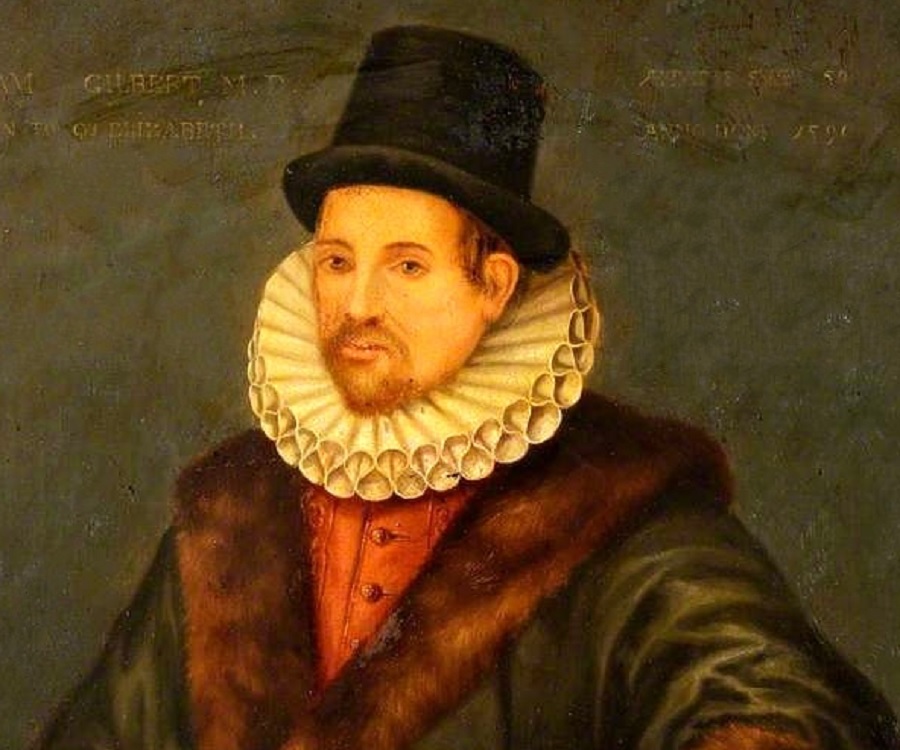
William Gilbert was an English physician, natural philosopher and physicist most noted for his seminal scientific work De Magnete, Magneticisque Corporibus, et de Magno Magnete Tellure. The book in which Gilbert elucidated several of his experiments with a small magnetised model ball called terrella representing the Earth, and gave full account on his research on magnetic bodies and electrical attractions, became a huge success and influenced many contemporary writers. Considered discoverer of the Earth's magnetic field, Gilbert through his experiments, concluded that the Earth acts as a giant magnet because of which compasses point north. He was the first one who argued that the centre of the Earth was iron. It is believed that terrella was invented by Gilbert while he investigated on magnetism. Reputed as inventor of the word electricity, Gilbert also considered static electricity produced by amber and referred to the phenomenon by the adjective electricus. He invented versorium, the first electroscope, in the form of a pivoted needle. It was the first instrument that was used to detect presence of static electric charge. Besides making his mark as a pioneer researcher into magnetism, Gilbert, an MD from Cambridge, also made his name as a physician and served as royal physician of Queen Elizabeth I and thereafter her successor King James I. Gilbert was a Fellow of the Royal College of Physicians and was later elected as President of the college.
Birthday: May 24, 1544 (Gemini)
Born In: Colchester , England, United Kingdom
Recommended For You
British Celebrities Born In May
Also Known As: William Gilberd
Died At Age: 59
father: Jerome Gilberd
mother: Hierome Gilbert, Jerome Gilberd
siblings: William Gilbert Junior
Born Country: England
Died on: November 30, 1603
place of death: London, England, United Kingdom
Cause of Death: Bubonic Plague
education: St John's College, Cambridge
Recommended For You
Gilbert was born on May 24, 1544, in Colchester, England, into the prosperous family of Jerome Gilberd and Elizabeth Coggeshall as their first child among four children. His father, a borough recorder, was counted among the important men in the town. Gilbert lost his mother at an early age following which his father married Jane Wingfield. Gilbert had seven half-siblings through his father’s second marriage.
Gilbert studied at the Colchester Royal Grammar School. He attended St John's College, Cambridge. He obtained his Bachelor of Arts degree in 1561, Master of Arts degree in 1564 and finally became Doctor of Medicine (M.D.) in1569. He then served as bursar of St John's College for some time before leaving for London to practice medicine.
In 1573, Gilbert settled in London and started to practice. Same year, he was elected a Fellow of the Royal College of Physicians of London. By 1581, he earned repute as a prominent physician in London and in the ensuing years, he was consulted by several members of the English nobility. Gilbert and three other physicians of the college were requested by the Privy Council in 1588 to take care of health of the men in the Royal Navy. He was elected President of the college in 1600. The following year, he became royal physician of the Queen of England and Ireland Elizabeth I and remained so until her death on March 24, 1603. Thereafter he was inducted as physician of James VI and I (King of Scotland as James VI and King of England and Ireland as James I).
Meanwhile, during the 1590s, Gilbert attempted for the first time to map the markings of the Moon’s surface. He studied the Moon’s surface and made the chart without using a telescope and outlined dark and light patches on the face of the Moon. He was of the opinion that the dark spots on the Moon were land while the light patches were water bodies.
Gilbert devoted most of his time, energy and resources in studying the Earth's magnetism. In 1600, he published his principal scientific work De Magnete, Magneticisque Corporibus, et de Magno Magnete Tellure (On the Magnet and Magnetic Bodies, and on That Great Magnet the Earth). The work consists of six books and includes elucidation of several experiments conducted by him using his model Earth called the terrella. Although it was earlier believed by some that the star called Polaris in the northern circumpolar constellation of Ursa Minor or a big magnetic island on the north pole attracted the compass, the experiments of Gilbert led him to explain that the Earth was itself a giant magnet due to which the compasses point north. To demonstrate this, Gilbert created a scale model of the magnetic Earth, a terrella (little Earth) a small magnetised model ball formed out of a lodestone. He passed a small compass over the ball and showed that the horizontal compass pointed towards the magnetic pole.
Gilbert became the first to rightly assert that the centre of the Earth was iron. He also considered that one of the important properties of magnets is that when they are cut into pieces, each piece forms a new magnet with north and south poles.
In De Magnete, Gilbert made a careful study of electricity and magnetism and considered static electricity produced by amber. He distinguished the lodestone effect from static electricity that is produced by rubbing amber. Amber in Greek is called elektron and in Latin is called electrum, and the new Latin word electricus, meaning like amber or of amber was coined by Gilbert to refer to the ability of amber in producing static electricity. He called its effect as the electric force. Often called the father of electrical studies, Gilbert was the first to use the terms electric force, electric attraction and magnetic pole paving way for the English words electric and electricity of which the latter was first used by Sir Thomas Browne in his 1646 published encyclopaedia, Pseudodoxia Epidemica,.
In 1600, Gilbert invented the versorium, the first electroscope and instrument used to detect presence of static electric charge on an object. Made of metal, the versorium is a needle akin to a compass needle, however unmagnetized. The versorium pivots freely on a pedestal and gets attracted and turns towards charged bodies when these are brought near it and thus have the ability to distinguish between charged and non-charged objects. Similar to the construction of the magnetic compass, the versorium is influenced by electrostatic forces instead of magnetic forces. Gilbert invented versorium at a time when differences between magnetic and electrical forces were not well understood. Through his experiments and through the versorium and the terrella, Gilbert endeavoured in proving that magnetic and electrical forces were two different types of forces and became the first to draw a clear distinction between static electricity and magnetism.
He strongly supported Earth's rotation in De Magnete and argued in favour of the Copernican System in Book 6, Chapter 3 of the treatise. Although he discussed in favour of diurnal rotation, he did not discuss about heliocentrism and posited that because of the inordinate distance of the huge celestial spheres, if at all they exist, it will be preposterous to think that they rotate daily as does the much smaller Earth. He asserted that fixed stars are at remote variable distances from the Earth and maintained that the planets were held in their orbits by a form of magnetism. He also said that the motion of the skies occurs because of rotation of the Earth instead of rotation of the spheres.
His rejection of ancient theories of magnetism and the meticulous way he elucidated his experiments in De Magnete led the treatise to become highly influential and successful, influencing several contemporary writers such as Francis Godwin and Mark Ridley. Gilbert however incorporated experiments on magnetism conducted by French mathematician, physicist, and writer Petrus Peregrinus de Maricourt in De magnete and acknowledged his debt to Peregrinus.
His book De Mundo Nostro Sublunari Philosophia Nova (New Philosophy about our Sublunary World), a quarto volume of 316 pages, was published posthumously in Amsterdam in 1651. It was edited by either his younger brother William Gilbert Junior or by distinguished English scholar and critic John Gruter from two manuscripts found in the library of English diplomat and politician Sir William Boswell.
Gilbert, a pioneer researcher into magnetism, was considered an imminent physician and man of science in England during the rule of Queen Elizabeth I.
He remained a bachelor all his life and resided in London at Wingfield House that served as a laboratory. He passed away on November 30, 1603, in London, possibly due to the bubonic plague that swept the city. He was interred in Holy Trinity Church in Colchester and a marble wall monument of this imminent English physician and physicist is still present in this Saxon church, which was later deconsecrated and is currently used as an arts centre and cafe.
Gilbert left his instruments, globes, books and minerals for the library of the the Royal College of Physicians, however the Great fire of London in 1666 destroyed many of the rooms of the college and most of the books.
A unit of magnetomotive force, the gilbert (Symbol: Gb), an obsolete unit used to measure magnetization in practical cgs and emu cgs systems was named in his honour. The Gilberd School, the coeducational secondary school located in Colchester, is also named after him.

How To Cite
People Also Viewed


Also Listed In