Childhood
According to the Gospel of Luke, the birth of John was prophesied to his father Zachariah, by the angel Gabriel, while the former was performing his functions as a priest, in the temple of Jerusalem. Since Zachariah was a priest of the course of Abijah and his wife Elizabeth was one of the daughters of Aaron, John became a descendant of Aaron from both his paternal and maternal side. The Gospel recounts that Mother Mary came to inform Elizabeth about her pregnancy. At that time, Elizabeth was in her sixth month of pregnancy and her unborn baby 'jumped for joy' in the womb only.
Ministry
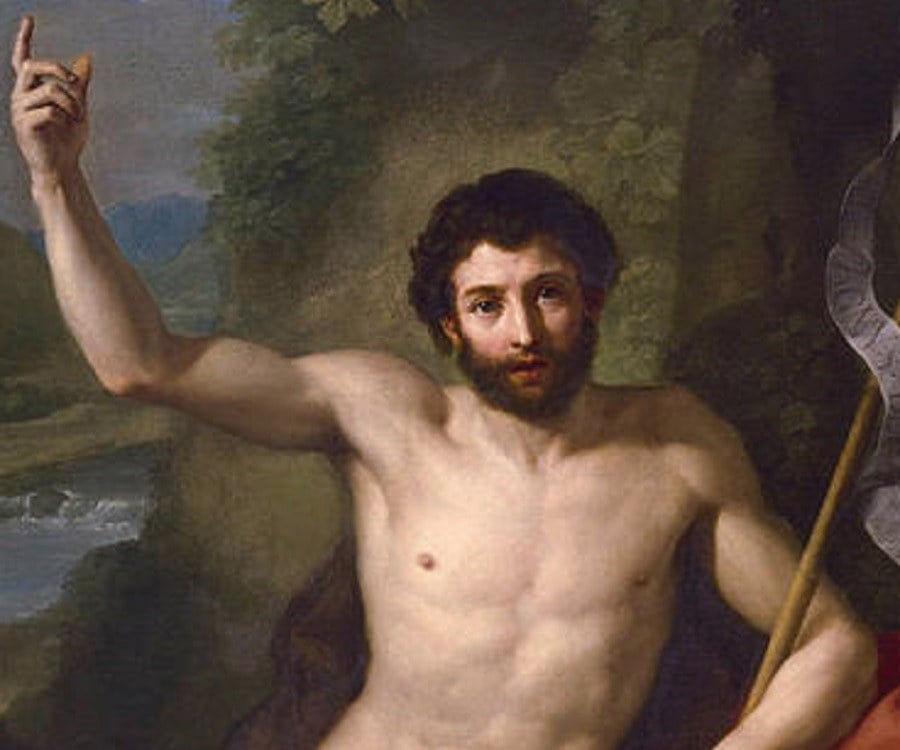
It is said that, at the age of thirty, John started to preach on the banks of the river Jordan. He preached against the evils of the time and attracted men to penance and baptism. His only message to people was to repent, as the Lord was coming. He baptized many people and, thus, was named John the Baptist. According to the Holy Scriptures, Christ also turned to John to attain baptism.The incident took place when John the Baptist's ministry was at its close. John instantly recognized the Lord and proclaimed Him to be the Messiah. John baptized Jesus, marking the beginning of Jesus' ministry. In turn, John inspired his followers to follow Christ
Death
After the baptism, Jesus is believed to have left to preach in Galilee, while John continued preaching in the Jordan valley. John's growing popularity and immense power created fright and fear in the minds of Herod Antipas, Tetrarch of Perea and Galilee. Following John's denunciation of his adulterous and incestuous wife Herodias, who was also the wife of his half brother Philip (Herod II), Antipas had him arrested and imprisoned at Machaerus Fortress, on the Dead Sea. On the other hand, Salome, the daughter of Herodias, impressed Antipas with a dance performance. Delighted by the girl's act, he vowed to grant her any wish. Salome, at the instigation of her mother, demanded the head of John the Baptist.
Prophecies Of John's Role
According to the Old Testament,John the Baptist was ordained by God to be a forerunner or precursor to the Messiah, Jesus Christ. All the four canonicalGospels also address his role. The need for a forerunner to the Messiah was not exceptional. However, Christians were expecting Elijah, a well-known prophet at the time, to come rather than John the Baptist. As a result, the disciples refused to accept John, only to understand later that Elijah had come through John only, but in a spiritual or allegorical sense.
John & Christian Traditions
According to the Eastern Orthodox, John was the last prophet who was acting as a bridge between the period of revelation and the New Covenant. It is also said that after death, he descended into Hades but kept on preaching about the coming of Jesus the Messiah. As per the Sacred Tradition, John the Baptist emerged at the time of death of people, who have not heard the Gospel of Christ to give them the good news about Christ's arrival.
Honors
Most of the Orthodox churches have an icon of St. John the Baptist on the iconostasis. His name is also mentioned during the Divine Services. All the Tuesdays of the year are dedicated to the memory of St. John the Baptist. Some Mediterranean countries also dedicate the summer solstice to St. John. The ritual performed in the solstice is analogous to midsummer celebrations on the Anglo-Saxon world, inspired in the Celtic festivity of Samhain. John the Baptist is also one of the saints, most frequently seen in the Christian art.
Feast Days
According to Luke, the Catholic calendar placed the feast of John the Baptist on June 24, six months before Christmas. However, there are six separate feast days that are dedicated to him. In chronological order, i.e. as per the church year, the feasts days fall on:
(Note: June 24th and August 29th are celebrated by the Roman Catholic Church as the feast days of John the Baptist)
Other Important Feast Days
Relics
Around the middle of the fourth century, the relics of John the Baptist were honored. As per the ancient tradition, the burial place of John was at Sebaste, in Samaria. History reveals the fact that under Julian the Apostate, around 362, the shrine of John was dishonored, but things changed eventually. Some portions of his relics were rescued and were first taken to Jerusalem. However, later, they were carried to Alexandria, where they were laid in the basilica, newly-dedicated to the Forerunner, on 27 May 395. Nevertheless, the tomb at Sebaste is visited by devotees even now.
As for the head of John, there is no proper information. While some consider that it was buried in the fortress of Machaerus by Herodias, the others are of the opinion that it was interred at Herod's palace at Jerusalem. A theory states that during the reign of Constantine I, the head of John the Baptist was found and deported to Emesa, in Phoenicia. It was concealed for several years, until it manifested by revelation in 453. However, the Aachen Cathedral holds the decapitation cloth of St. John. According to the claims made by Coptic Christian Orthodox Church, some relics of John the Baptist are also kept there. There is no specific record about the remains of John the Baptist, as there have been inconsistencies in the various legends. To add to the confusion, there are various claimants for his relics throughout the Christian world.
Churches and Other Establishments Named After John
Famous Churches After John
|
|
Recently Added
Gustavus Theodore von Holst
Charles Gounod
Rodolfo Amoedo
Michael Tippett
Jacopo Amigoni
Lizzy Ansingh
Friedrich von Amerling
Edmond Aman-Jean
Milton Avery
Karel Appel